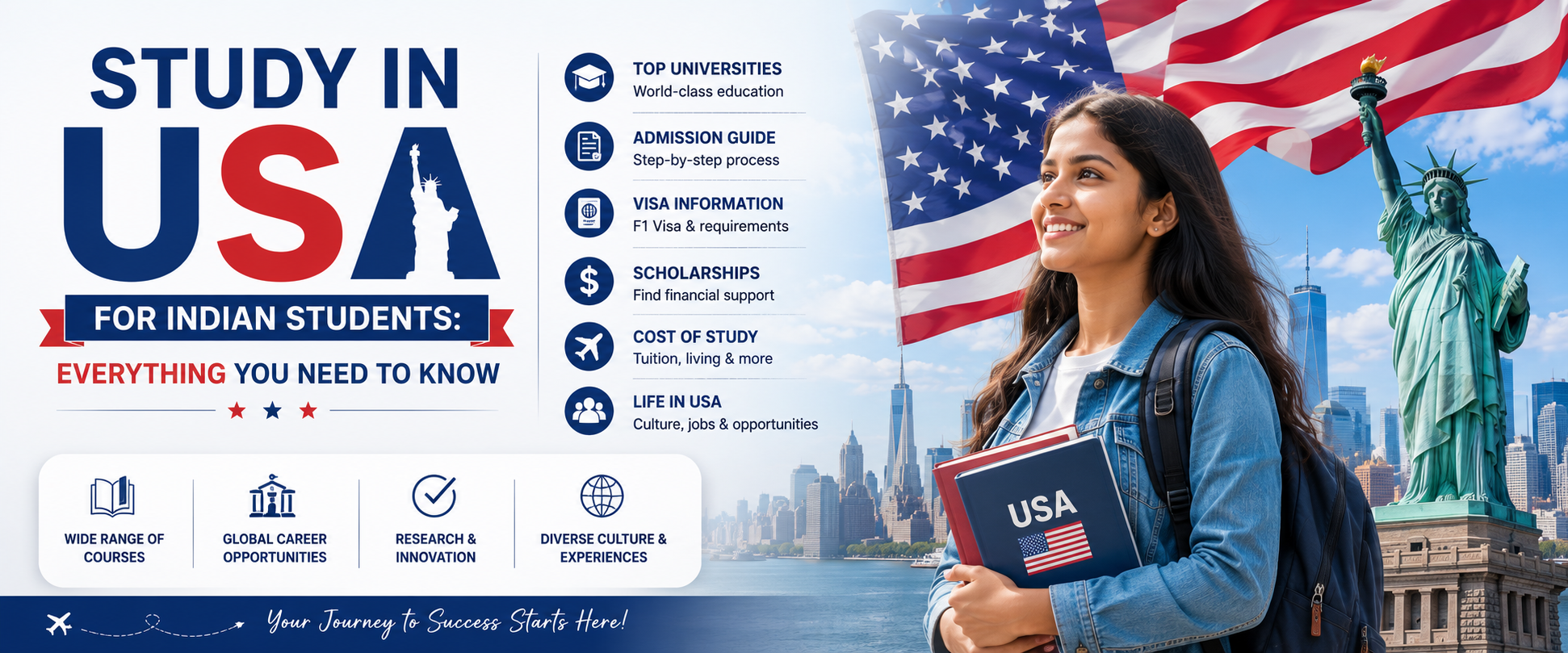
The United States remains one of the most popular destinations for higher education. Every year, thousands of Indian students choose to study in USA because of its world-class universities, globally recognized degrees, excellent research opportunities, and outstanding career prospects.
Whether you’re planning for undergraduate, postgraduate, MBA, or STEM programs, this comprehensive guide explains everything about studying in USA for Indian students, including eligibility, admission process, student visas, tuition fees, scholarships, and post-study work opportunities.
Looking for expert guidance? Way2Abroad Consulting helps students choose the right university, prepare visa applications, and achieve their dream of studying in the USA.
Why Study in USA?
The USA is home to over 4,000 accredited colleges and universities offering programs in almost every academic field.
Benefits of Studying in USA
- Globally ranked universities
- Flexible education system
- Wide range of courses
- Cutting-edge research facilities
- High employability
- International student support
- Optional Practical Training (OPT)
- Strong career opportunities after graduation
Many universities also provide internships, campus placements, and industry collaborations that help students gain practical experience.
Top Universities in USA for Indian Students
Some of the most popular universities include:
- Harvard University
- Stanford University
- Massachusetts Institute of Technology (MIT)
- University of California, Berkeley
- University of Michigan
- Carnegie Mellon University
- New York University
- Arizona State University
- Purdue University
- University of Texas at Austin
These institutions consistently rank among the world’s best for academic excellence and research.
Popular Courses in USA
Indian students commonly choose:
- Computer Science
- Artificial Intelligence
- Data Science
- Business Administration (MBA)
- Finance
- Engineering
- Cyber Security
- Healthcare
- Biotechnology
- Nursing
- Hospitality Management
- Architecture
The USA offers practical learning with access to internships and research projects.
Eligibility to Study in USA for Indian Students
Admission requirements vary by university but generally include:
Undergraduate Programs
- Completed Class 12
- English proficiency test
- SAT/ACT (if required)
- Academic transcripts
Master’s Programs
- Bachelor’s degree
- Good academic performance
- IELTS/TOEFL
- GRE/GMAT (depending on program)
- Statement of Purpose
- Letters of Recommendation
- Resume
English Language Requirements
Most universities accept:
|
Test |
Minimum Score |
|
IELTS |
6.0–7.5 |
|
TOEFL iBT |
80–100+ |
|
PTE Academic |
55–70 |
|
Duolingo English Test |
Accepted by many universities |
Always verify individual university requirements.
Cost of Studying in USA
Average annual tuition fees:
|
Course |
Tuition Fee (USD) |
|
Undergraduate |
$20,000–45,000 |
|
Master’s |
$22,000–55,000 |
|
MBA |
$40,000–80,000 |
Additional living expenses:
- Accommodation
- Food
- Transportation
- Health Insurance
- Books
Average annual living cost ranges between USD 12,000–18,000, depending on the city.
Scholarships for Indian Students
Several scholarships help reduce study costs.
Popular scholarships include:
- Fulbright-Nehru Scholarship
- Tata Scholarship
- Inlaks Scholarship
- AAUW Scholarships
- University Merit Scholarships
- Graduate Assistantships
Many universities also offer tuition waivers for high-performing students.
USA Student Visa (F-1 Visa)
Indian students typically require an F-1 Student Visa.
Documents Required
- Valid Passport
- University Admission Letter (I-20)
- SEVIS Fee Receipt
- Visa Application (DS-160)
- Financial Documents
- Academic Certificates
- Passport-sized Photographs
Visa interviews focus on genuine study intent, finances, and future plans.
Admission Process
Step 1
Research universities and courses.
Step 2
Check eligibility requirements.
Step 3
Prepare IELTS/TOEFL/GRE if required.
Step 4
Submit applications.
Step 5
Receive admission offer.
Step 6
Accept admission and receive Form I-20.
Step 7
Apply for your F-1 Visa.
Step 8
Arrange accommodation and travel.
Can Indian Students Work While Studying?
Yes.
International students can generally work:
- Up to 20 hours/week during semesters (on-campus)
- Full-time during official breaks
- Optional Practical Training (OPT)
- Curricular Practical Training (CPT)
These opportunities help students gain work experience while studying.
Post-Study Work Opportunities
After graduation, students can apply for:
- OPT (Optional Practical Training)
- STEM OPT Extension
- H-1B Work Visa (subject to eligibility)
The USA offers excellent long-term career opportunities in technology, healthcare, finance, engineering, and business.
Why Choose Way2Abroad Consulting?
Way2Abroad Consulting provides complete assistance for students planning to study abroad.
Our services include:
- University Selection
- Course Guidance
- Profile Evaluation
- SOP & LOR Assistance
- Scholarship Guidance
- Visa Documentation
- Visa Interview Preparation
- Education Loan Assistance
- Pre-Departure Support
Our experienced counselors help students secure admissions at leading universities across the USA.
FAQ's
The USA offers globally recognized degrees, top-ranked universities, flexible education systems, excellent research opportunities, and strong career prospects. Students also benefit from internships, Optional Practical Training (OPT), and exposure to diverse cultures.
The average tuition fee ranges from USD 20,000 to USD 55,000 per year, depending on the university and program. Living expenses typically range between USD 12,000 and USD 18,000 annually.
Indian students usually need an F-1 Student Visa to pursue full-time academic programs at accredited U.S. institutions.
Yes. Students on an F-1 visa can work up to 20 hours per week on campus during academic sessions and full-time during scheduled breaks. Eligible students may also participate in CPT and OPT programs.
Yes. Many universities and organizations offer merit-based and need-based scholarships, including the Fulbright-Nehru Fellowship, Tata Scholarship, Inlaks Scholarship, and university-specific financial aid.