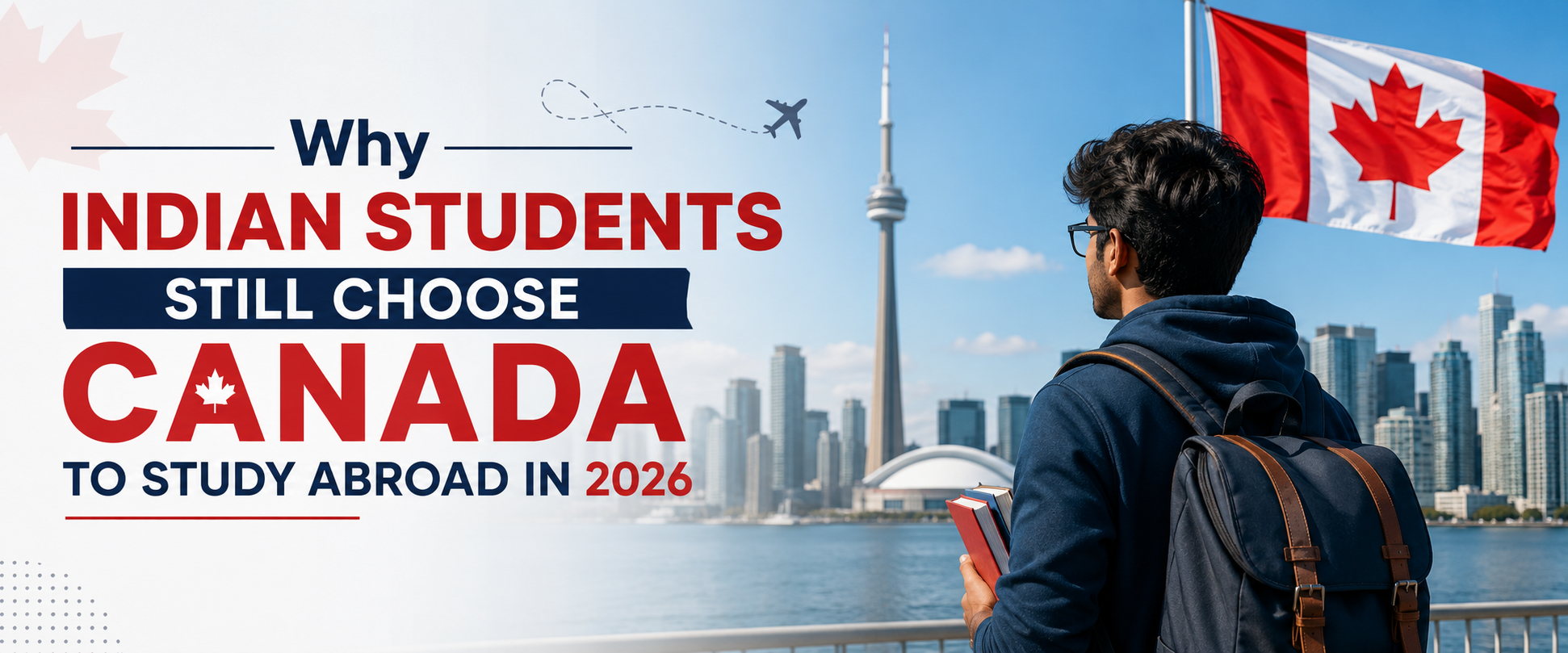
Is Canada Still the Right Study Destination for Indian Students in 2026?
Absolutely — but the rules have changed, and preparation matters more than ever.
Canada has consistently been the number one study-abroad destination for Indian students. More than 427,000 Indian students were enrolled in Canadian institutions in 2025, making India the single largest source of international students in the country. No other destination combines world-class universities, genuine post-study work rights, and a clear pathway to permanent residency the way Canada does.
But 2026 has brought significant policy changes — new permit caps, stricter documentation requirements, and revised financial proof thresholds — that have made the application process more competitive. Students who apply without proper guidance are facing rejection at record rates.
This complete guide covers everything Indian students need to know about how to study in Canada in 2026 — and explains why working with a trusted consultancy for study in Canada like Way2Abroad gives you the strongest possible chance of success.
What Has Changed: Canada’s New Rules for Indian Students in 2026
Understanding the 2026 updates is the most important first step for any Indian student planning to study abroad in Canada.
1. National Study Permit Cap
Canada has reduced its total study permit target for 2026, and the number of spots available for brand-new international students arriving for the first time is significantly lower than in previous years. Competition for these spots is intense — especially for Indian applicants, who have historically been the largest group.
2. PAL/TAL — Provincial Attestation Letter Now Required
Most undergraduate applicants must now obtain a Provincial or Territorial Attestation Letter (PAL/TAL) from their province before they can apply for a study permit. Without this letter, the application cannot be processed.
Important 2026 Update: Master’s and PhD students at public Designated Learning Institutions (DLIs) are fully exempt from the PAL/TAL requirement as of January 1, 2026 — making graduate programmes significantly more accessible than undergraduate pathways this year.
3. Higher Financial Proof Requirements
Canada has raised its financial proof requirements substantially. Applicants must now demonstrate they can cover tuition, travel, and a higher threshold of living expenses than previously required. This is one of the most common reasons Indian applications are currently being rejected.
4. Work Rights During Studies
Students can now work 24 hours per week off-campus during semesters — an increase from the previous 20-hour limit — and full-time during scheduled academic breaks. This helps students manage day-to-day living expenses while studying.
5. PGWP — Post-Graduation Work Permit Rules Tightened
The Post-Graduation Work Permit (PGWP) — which allows graduates to work in Canada for up to 3 years after completing their degree — now has stricter eligibility rules. Whether you qualify, and for how long, depends heavily on your programme level and field of study.
University degree holders (bachelor’s, master’s, PhD) at public institutions retain strong PGWP access. Certain private college diploma graduates face reduced or no PGWP eligibility in 2026.
This is the single most important reason to consult an expert before choosing your programme. The wrong programme choice can eliminate your post-study work rights and PR pathway entirely.
Why Canada Remains the Top Study Abroad Destination for Indian Students
Despite the tighter policies, no other country offers what Canada delivers as a complete package for Indian students.
World-Ranked Universities with Global Recognition
Canada is home to internationally recognised institutions — University of Toronto, UBC, McGill, McMaster, University of Waterloo, and University of Alberta — all ranked in the global top 250 by QS 2026. Degrees from these universities are recognised by employers worldwide across STEM, business, health sciences, law, and the arts.
The Clearest Permanent Residency Pathway in the English-Speaking World
Canadian work experience gained through the PGWP directly qualifies graduates for Express Entry (Federal Skilled Worker programme) and Provincial Nominee Programs (PNPs). No other English-speaking country provides a more transparent and accessible student-to-permanent-resident pipeline.
More Affordable Than the US and UK
Canada offers equivalent or superior university quality at significantly lower tuition costs compared to the United States and United Kingdom — particularly for STEM and business programmes. This makes Canada an exceptional value destination for Indian families investing in international education.
Safe, Multicultural, and Welcoming to Indians
Canada consistently ranks among the world’s safest countries. The Indian diaspora is the largest visible minority community in Canada, with deep cultural networks across Toronto, Vancouver, Brampton, Surrey, Calgary, and Ottawa. Indian students consistently report feeling at home from day one.
Top Canadian Universities for Indian Students in 2026
Way2Abroad has partnerships with 350+ Canadian institutions. Here are the most popular universities among Indian students:
|
University |
Location |
Strengths |
|
University of Toronto |
Toronto, Ontario |
Research, Medicine, Business, Law |
|
University of British Columbia |
Vancouver, BC |
Engineering, Sciences, Forestry |
|
McGill University |
Montreal, Quebec |
Medicine, Law, Arts, Sciences |
|
University of Waterloo |
Waterloo, Ontario |
Computer Science, Engineering, Co-op |
|
McMaster University |
Hamilton, Ontario |
Health Sciences, Engineering, Business |
|
University of Manitoba |
Winnipeg, Manitoba |
Agriculture, Sciences, Engineering |
|
University of Windsor |
Windsor, Ontario |
Business, Law, Engineering |
|
Lakehead University |
Thunder Bay / Orillia |
Business, Education, Sciences |
|
Fanshawe College |
London, Ontario |
Applied Arts, Technology |
|
Centennial College |
Toronto, Ontario |
Business, Technology, Health |
Best Courses to Study in Canada for Indian Students in 2026
Choosing the right programme is more critical in 2026 than it has ever been — because your PGWP eligibility and PR pathway depend directly on it.
High-Demand Fields Added to PGWP-Eligible List (IRCC, 2025):
- Healthcare and Nursing
- Data Science and Artificial Intelligence
- Software Engineering and Information Technology
- Civil and Electrical Engineering
- Education and Teaching
- Skilled Trades
Consistently Strong Career and PR Pathways:
- MBA and Business Administration
- Computer Science
- Cybersecurity
- Financial Management
- Supply Chain and Logistics
Way2Abroad’s counsellors cross-reference every student’s academic background with IRCC’s current PGWP-eligible programme list before recommending universities — ensuring your degree actually opens the door to working and settling in Canada after graduation.
Canada Student Visa Process for Indian Students — Step by Step
The Canadian study permit process has more steps in 2026 than in previous years. Here is exactly what it involves:
Step 1: Choose a Designated Learning Institution (DLI) Only institutions on IRCC’s DLI list can support your study permit. All public universities and most recognised colleges in Canada are DLIs. Way2Abroad helps you identify the right institution for your academic profile and career goals.
Step 2: Secure a Letter of Acceptance (LOA) Apply to your chosen institution and receive an official Letter of Acceptance before beginning the visa process.
Step 3: Obtain a PAL/TAL (Undergraduate Students Only) Your institution will apply for a Provincial Attestation Letter on your behalf. This is now mandatory for most undergraduate applicants before a study permit application can be submitted. Master’s and PhD students at public DLIs are exempt.
Step 4: Arrange Financial Proof You must demonstrate sufficient funds to cover your tuition and living expenses per IRCC’s 2026 requirements. This typically involves setting up a GIC (Guaranteed Investment Certificate) through an IRCC-approved bank — a deposit that is returned to you in monthly instalments once you arrive in Canada.
Step 5: Prepare Your Complete Document Set
- Valid passport (minimum 2 years validity recommended)
- Letter of Acceptance from a DLI
- Academic transcripts and certificates
- English proficiency scores (IELTS, TOEFL, PTE, or Duolingo)
- Statement of Purpose (SOP)
- Letters of Recommendation (LORs)
- Financial proof documentation
- Biometrics
Step 6: Submit via SDS or Non-SDS Route The Student Direct Stream (SDS) is available to Indian students and offers significantly faster processing — typically around 20 days. Way2Abroad files the majority of Canadian applications through the SDS pathway and maintains a 99% visa success rate.
Step 7: Complete Biometrics Attend a biometrics appointment at a designated Visa Application Centre (VAC) in India.
Step 8: Receive Your Study Permit and Travel Once approved, finalise your accommodation, attend Way2Abroad’s pre-departure briefing, and fly to Canada with full confidence.
Scholarships for Indian Students in Canada — 2026
Way2Abroad has helped students secure over ₹10 Crore in scholarships. Key options for Indian students include:
- Vanier Canada Graduate Scholarships — for doctoral students, one of Canada’s most prestigious awards
- Ontario Graduate Scholarship — for graduate students at Ontario universities
- University of Toronto International Scholar Award — merit-based award for high-achieving international students
- UBC International Leader of Tomorrow Award — need and merit-based, covering significant tuition costs
- University of Waterloo International Student Award — for undergraduate international students
- McGill Entrance Scholarships — for outstanding international undergraduate applicants
- Atlantic Canada Province Bursaries — especially generous for students who commit to settling in New Brunswick, Nova Scotia, or Prince Edward Island after graduation
Way2Abroad’s counsellors identify every scholarship your profile qualifies for and prepare your scholarship applications alongside your university applications — at no extra step for you.
Why Work with a Consultancy for Study in Canada?
With study permit approval rates for Indian applicants under significant pressure in 2025–26, the stakes of getting your application wrong have never been higher. A rejected visa application means lost time, lost money, and a delayed future.
Here is what Way2Abroad’s Canada study consultancy does that self-applicants simply cannot replicate:
|
Challenge Without a Consultant |
How Way2Abroad Solves It |
|
Choosing a programme with no PGWP eligibility |
Counsellors cross-check every programme against IRCC’s PGWP list |
|
Insufficient or incorrectly structured financial documents |
Guided GIC setup and documentation review |
|
Missing PAL/TAL for undergraduate applicants |
Full coordination with institutional teams |
|
Weak SOP that doesn’t reflect your profile |
Professional SOP writing and review |
|
Applying to the wrong university tier |
Profile-based shortlisting from 350+ partner institutions |
|
Visa rejection due to documentation gaps |
SDS-route filing with 99% visa success rate |
|
Confusion after arrival |
Pre-departure briefing, accommodation guidance, and post-arrival support |
Way2Abroad’s Canada Results — By the Numbers
- 2,000+ students successfully placed in Canadian institutions
- 99% visa success rate across all Canada applications
- ₹10 Crore+ in scholarships secured for students
- 350+ partner universities and colleges in Canada
- Certified counsellors trained in the latest IRCC policies and SDS procedures
Your Canada Journey Starts With One Conversation
Canada’s 2026 rules have raised the bar — but for students who plan correctly, the rewards are greater than ever. A Canadian degree still opens the door to world-class employment, a globally respected qualification, and one of the most welcoming permanent residency systems in the world.
Way2Abroad has guided 2,000+ Indian students to Canadian universities with a 99% visa success rate. Whether you are planning a bachelor’s, master’s, or diploma programme — our certified counsellors handle every step of the journey, from shortlisting universities to landing in Canada.
👉 Book Your FREE Canada Study Consultation — Way2Abroad
📞 +91 9849137901 📧 info@way2abroadconsulting.com
FAQ's
Yes. Canada remains the top study destination for Indian students. The key is applying with the right programme, the right documentation, and expert guidance — which is exactly what Way2Abroad provides.
Yes, Indian students need a valid UK study visa to study legally in the United Kingdom.
The Provincial or Territorial Attestation Letter is a document issued by a Canadian province that confirms your enrolment falls within that province's international student quota. Most undergraduate applicants need it before filing a study permit. Master's and PhD students at public universities are exempt as of January 2026.
Yes. International students can work 24 hours per week off-campus during semesters and full-time during scheduled academic breaks. This helps significantly with day-to-day living expenses.
The Post-Graduation Work Permit allows graduates from eligible Canadian programmes to work in Canada for up to 3 years after graduation. It is the primary route to gaining Canadian work experience, which then qualifies you for Express Entry or a Provincial Nominee Program for permanent residency.